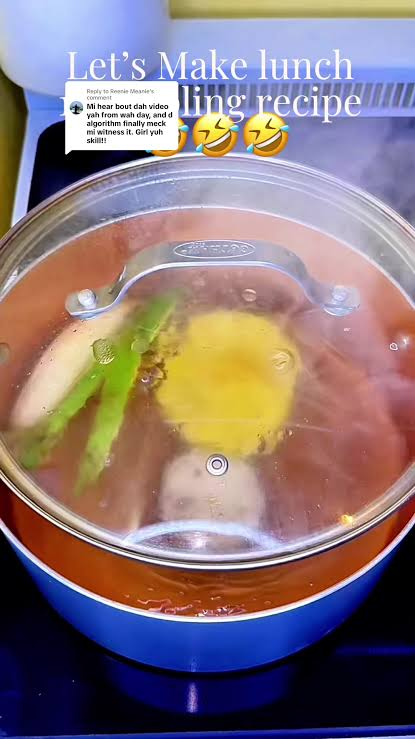
One dumpling, one banana and one piece of yam. That was enough to get Jamaican TikTok talking. When @1dumplinggeneral posted a follow-up showing her brown stew fish and ground provision, she joked that viewers still couldn’t get over her making just one dumpling (1dumplinggeneral, 2026). Some were surprised she could mix flour for just one. Others called her mean. Then the requests started coming in. Could she make one cup of porridge? One cup of soup? One slice of cake? By November 12, 2026, the follow-up had more than 345,000 views and 3,800 shares. Somewhere along the way, a meal for one became everybody’s business.
Plenty of us love a good story, even when the story is how much yam somebody boiled. A creative person can take something that ordinary and make you want to see what happens next. But imagine having to get people to stop scrolling today, then come back tomorrow and do it all over again. When thousands of creators are competing for the same few seconds and views can help pay your bills, the pressure can change how you tell the story. The headline gets a little more dramatic. A small disagreement becomes a three-part saga. Clickbait has been around for years, but social media gives creators a reason to keep turning it up. If the exaggerated version gets more attention, why would a creator who depends on views go back to telling it straight?
TikTok’s For You feed helps explain that pressure. The platform considers what people watch, skip, share and comment on, along with details such as sounds, hashtags, language preferences and where a video was posted. For most users, interactions such as time spent watching tend to carry more weight (TikTok, n.d.). Think about the last video you stayed to watch even though you disagreed with it. You might have been waiting to hear how far the person would go, but the time you spent watching can still count as a signal of interest.
When the Culture Gets People Talking
I saw a different kind of debate around the Hill & Gully Riddim. In April 2026, Stephen “Di Genius” McGregor reworked the Jamaican folk song “Hill an’ Gully Rider” into a dancehall riddim. Broadcaster Fae Ellington welcomed the revival but objected to the explicit lyrics some artistes put over it (Jamaica Observer, 2026). Were we “forgetting our recipes”, as people say on TikTok, or finding a way to introduce younger Jamaicans to a folk song they might never have heard at home?

I can see why people felt protective of a song they grew up with. I also see the value in using dancehall, another part of our culture, to get young people curious about the music that came before it. The debate gave people a reason to share the tracks and explain what the original song meant to them.
For a small business, the part I’d borrow is the way a familiar reference invites people into the conversation. If everybody’s already talking about a hot topic and it makes sense for your brand to weigh in, there could be one well-timed post that puts your brand on the map. Either way, give people something to recognise and respond to without picking a fight in the caption.
Keeping Up Without Losing Your Voice
A timely post can get a small business into the conversation. The harder part is keeping up when the feed has already moved on to the next thing. That’s where AI comes in for me. It can help a small team get a post ready faster, but I’d still want someone on the team to ask, “Does this sound like us?”
I’d use AI to brainstorm, polish a caption or clean up the background in a real product photo. Where I draw the line is what the edit leads a customer to believe. If a skincare brand uses AI to smooth someone’s skin in a demonstration, I want that disclosed. The same goes for an AI-generated person showing the product. A viewer could come away thinking a real person used it and got those results. If I were making that video, I’d show the real product on real skin.
As a designer, I’ve had trouble finding images that feel Jamaican since before I started using AI. A stock photo can feature Black people and still look like it was taken somewhere else. Sometimes it’s the setting, the styling or how the lighting makes the skin look. AI can reproduce those same defaults, so I give it local references and check what it produces. I hear a similar gap in voiceovers. A tool can get the Patwa words right and still miss how we’d actually say them. In one study, researchers found that an off-the-shelf speech recognition model struggled to transcribe Jamaican Patwa music. Its performance improved after training on manually transcribed material (Madden et al., 2025). That’s a good reason to review automated captions and record a local voiceover when the delivery matters. I’d also check where my viewers are coming from. TikTok considers region and language, and the audience for a Jamaican post can be spread across the island and the diaspora (TikTok, n.d.).
Make the Most of a Small Budget
A small business has to keep showing up in a crowded feed while giving customers something they can trust. For a Jamaican skincare brand, one shoot day could yield weeks of content: real product photos, demonstrations on real skin and voiceovers that sound like the people the brand is speaking to. AI can help stretch that material by polishing captions or tidying the background of a product shot. It can also help brainstorm a month’s worth of tips that the team can review and turn into graphics with Canva’s Bulk Create.
That same pressure to keep up is why it helps to give each post a job. A funny video with 20,000 views can introduce people to the brand. A product demo with 2,000 views can help someone decide whether to try it. Each video serves a different stage of the buyer’s journey, from building awareness to creating desire. If the caption says “DM us to order”, give viewers a keyword to send and track how many enquiries become orders. That tells the business whether the attention it worked to earn led to the action it asked for.
My Blog vs. the AI Version
Both blogs argue that social media rewards attention and that businesses should measure what people do after watching. My blog starts with one dumpling and uses the Hill & Gully debate to show how Jamaicans shape what gets talked about online. The AI version takes a broader Caribbean approach, using a Tobago tour operator to explain the difference between getting views and getting bookings. We also approach trust differently. I focus on creative decisions a small brand might make, like smoothing someone’s skin in a skincare demo. The AI version uses a deepfake in Trinidad and Tobago to ask what counts as a credible endorsement. Its example shows the wider stakes, while mine shows where I’d draw the line in everyday marketing.
References
1dumplinggeneral [@1dumplinggeneral]. (2026, October 22). Replying to @Reenie Meanie Good morning, mi TikTok family! 🤣🇯🇲 Since unnu can’t get over mi one dumpling, mi decided [Video]. TikTok. https://www.tiktok.com/@1dumplinggeneral/video/7699457680770927886
Jamaica Observer. (2026, May 11). Fae Ellington criticises ‘vulgar’ songs on Hill & Gully Riddim. https://www.jamaicaobserver.com/2026/05/11/fae-ellington-criticises-vulgar-songs-hill-gully-riddim/
Madden, J., Stone, M., Johnson, D., & Geddez, D. (2025). Towards robust speech recognition for Jamaican Patois music transcription [Preprint]. arXiv. https://arxiv.org/abs/2507.16834
TikTok. (n.d.). How TikTok recommends content. TikTok Help Center. https://support.tiktok.com/en/using-tiktok/exploring-videos/how-tiktok-recommends-content


Leave a Reply